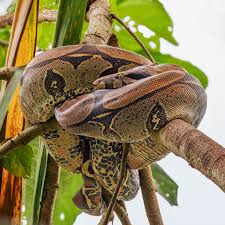
Boa Constrictor
Intelligent, beautiful, and built for a lifelong bond — boas are a serious commitment that rewards experienced keepers.
Boa constrictors are one of the most iconic snake species in the pet trade, and with good reason. They are intelligent, responsive, and come in a range of beautiful localities and morphs. Common boas from Colombia and Central America are the most frequently kept and are known for their relatively calm dispositions. They are a commitment — a healthy boa can live 25 to 30 years — but for someone ready for that relationship, they are incredible animals. Expect an adult female to reach 8 to 10 feet and adult males 6 to 8 feet.
Diet & Feeding
Boas eat pre-killed or frozen-thawed rodents and rabbits, sized appropriately to the width of the snake at mid-body. Juveniles eat mice every 7 to 10 days. Adults eat large rats or small rabbits every 2 to 4 weeks. Always use frozen-thawed prey — live animals can and do injure snakes. Feed in the enclosure or a separate feeding tub. Wait 48 to 72 hours after feeding before handling to prevent regurgitation.
Housing & Habitat
A baby boa can live in a 20-gallon enclosure. Adults need a minimum 6-foot by 3-foot enclosure — a custom PVC enclosure is ideal. Front-opening doors make access easier and reduce stress on the snake. Substrate options include coconut fiber, cypress mulch, or paper towels. Provide a large hide, a sturdy climbing branch if space allows, and a water dish large enough to soak in. Security is important — boas are strong and will push through any weak lid.
Temperature & Lighting
The warm side should be 88 to 92 degrees Fahrenheit and the cool side 78 to 82 degrees. Ambient temperature should not drop below 75 degrees at night. Use radiant heat panels or ceramic heat emitters controlled by a thermostat. Humidity should be maintained at 60 to 70 percent to support good shedding. A larger water bowl and cypress mulch substrate both help maintain humidity.
Handling & Temperament
Common boas can become very handleable with consistent interaction. Young boas may be nippy, but most settle down with regular gentle handling. Always use a hook to break feeding response before picking up — this avoids getting bit when the snake is in feeding mode. Support the body when holding, especially with large adults. Never handle alone when your boa exceeds 8 feet — always have a second person present as a safety precaution.
Health Notes
Boas are generally hardy, but common issues include respiratory infections from low temperatures, mites, inclusion body disease (IBD — a fatal viral disease), and scale rot from high humidity with dirty substrate. Buying from a reputable breeder and having a new snake tested by a vet greatly reduces disease risk. Annual fecal tests are a good idea for parasite screening.