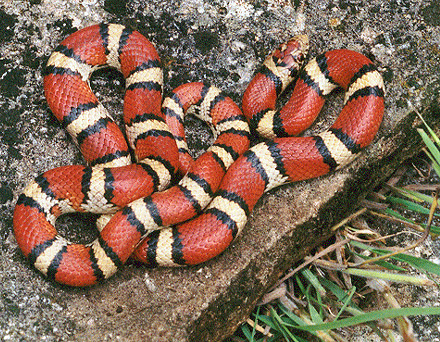
Milk Snake
Boldly banded and full of attitude — milk snakes are a beautiful step up from a corn snake with plenty of personality to match.
Milk snakes are beautifully banded, non-venomous snakes that are closely related to king snakes. Their bold red, black, and yellow or white bands have historically led to confusion with venomous coral snakes. They are native to a huge range across North and South America, and the various subspecies vary considerably in appearance. Milk snakes are great intermediate pet snakes — a bit feistier than corn snakes as hatchlings, but they tame down nicely. They typically live 12 to 20 years.
Diet & Feeding
Milk snakes eat pre-killed or frozen-thawed mice, sized appropriately to the width of the snake. Hatchlings eat pinky mice every 5 to 7 days. Adults eat adult mice every 7 to 14 days. Some hatchlings initially prefer lizard-scented prey (a piece of shed skin rubbed on a pinky mouse) before transitioning to regular mice. Always use frozen-thawed prey to eliminate the risk of injury from live rodents.
Housing & Habitat
Hatchlings can start in a small enclosure (6 to 10 gallon) — too much space stresses young snakes. Adults need a 40-gallon enclosure or equivalent. Provide two hides and a water dish. Aspen shavings, coconut fiber, and cypress mulch all work well as substrate. A secure lid is essential — milk snakes are excellent escape artists. Do not house milk snakes with other species; they may attempt to eat them.
Temperature & Lighting
The warm side should be 85 to 88 degrees Fahrenheit with a cool side around 72 to 78 degrees. Under-tank heaters or radiant heat panels on a thermostat work well. UVB is not required but may be beneficial. Milk snakes tolerate a reasonable range of temperatures and are quite hardy.
Handling & Temperament
Hatchling milk snakes can be defensive and musking and striking is not uncommon at first. With regular gentle handling, most tame down well within a few months. Adults are generally calmer and make good handling snakes. Use a hook to start interactions with defensive individuals. Handle in a calm, low-traffic environment and avoid sudden movements.
Health Notes
Milk snakes are generally very healthy and hardy when kept properly. Common issues include respiratory infections from cold or damp conditions, mites, and stuck sheds from low humidity. Mouth rot and intestinal parasites are less common but possible. Annual fecal screenings are a sensible precaution.