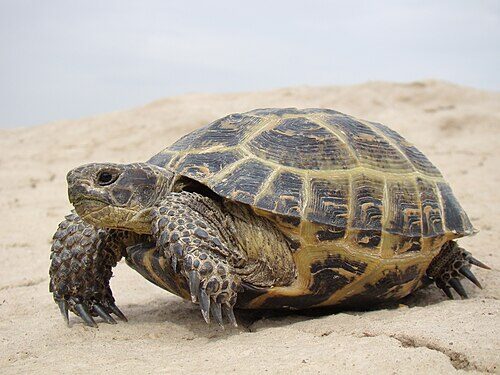
Russian Tortoise
Compact, active, and full of personality — Russian tortoises are among the hardiest and most enjoyable tortoises for home keepers.
Russian tortoises are one of the best tortoise species for beginners and experienced keepers alike. Native to Central Asia, they are adapted to arid environments with hot summers and cold winters. They are compact (4 to 8 inches), personable, and develop recognizable individual personalities. Russian tortoises are active, curious, and can become very responsive to their owners over time. They are also more cold-hardy than many tortoise species. With excellent care, Russian tortoises can live 50 to 80 years.
Diet & Feeding
Russian tortoises are strict herbivores and should be fed a high-fiber, low-protein, low-fruit diet. The majority of their diet should be grasses, hays (timothy, orchard grass), and weeds (dandelion, plantain, clover). Supplement with dark leafy greens like collard greens, mustard greens, and turnip greens. Avoid fruit, high-sugar vegetables, and protein. Calcium supplementation is important — dust food several times per week. Overfeeding causes pyramiding of the shell.
Housing & Habitat
Russian tortoises need more space than their size suggests — they are active diggers and roamers. Outdoors in a warm climate is ideal: a tortoise table at least 4 by 8 feet or an outdoor pen. Indoors, a 4-foot by 4-foot enclosure with 4 to 6 inches of substrate for digging is the minimum. They need UVB lighting, a warm basking area, and a hide. They are prolific diggers and will escape under any fence without a buried barrier.
Temperature & Lighting
The basking spot should be 95 to 100 degrees Fahrenheit. The cool side should be around 75 to 80 degrees. UVB is absolutely essential and should be a high-output T5 HO bulb. Russian tortoises can be overwintered (hibernated), but this should only be done with healthy, well-fed animals under proper protocols.
Handling & Temperament
Russian tortoises become comfortable with regular gentle interaction. Many will take food from your hand and learn to associate their keeper with positive experiences. They walk rapidly for tortoises and can cover more ground than expected. Handle them close to the ground and support their body. Avoid dropping them, as shell injuries can be serious.
Health Notes
Metabolic bone disease and shell abnormalities (pyramiding) from inadequate UVB and diet are the primary concerns. Respiratory infections, runny nose syndrome (caused by Mycoplasma), parasites, and eye infections are also possibilities. Any tortoise with wheezing, nasal discharge, or swollen eyes should see a reptile vet promptly.